3.2.09

Appealing Appetizing pt. 1

Dear Good Friend,

I have long since ceased trying to understand the notion of "food fetishes"- saliva dissolving underwear, licking melted chocolate off a loved ones torso etc.- I dismiss the phenomenon as a happening that is just not meant for me.

What has come to irk me in recent weeks (I have waited to write you regarding this under the hope that the nagging will stop) is the appeal of personified products that (who?) take on the archetypes of the "sexy" one. I know there was a Squeeze-It Juice that (who?) fits into this category, also I'm almost sure there is a flavor of Runtz Candy of this variety as well. Look, I know this trend isn't new, I can trace it without much exertion back to the movie previews of the 1950's (I believe the Soda and/or Popcorn was "sexy"), but I cannot find a reason I can totally buy into for the purpose of these characterizations. I don't know where I'm going with this, but friend, I wanted to drop you a line so we can keep the lines of communication open in case you've lost sleep over this silly quandary as well.

As always, thank you,

Death Mask

1.2.09

Our Turn to Change


Dear YHTALMM enthusiasts,

As I'm sure you've heard, 2009 is a year of change--and our blog has no intention of being left in the era without change. We're changing too: in fact we've been in the midst of changing for the last few months. Months, that we're sure to you, seemed like months of silence. And in some ways this is true--my midrest stirrings have ceased and I no longer awaken to find food wrappers strewn in my sheets. While I'm grateful for said "clean" emergences into consciousness, I am not convinced that I have overcome the beast who demands to be fed while I rest. Instead, I believe I have catered (no pun intended) to the monster. Recently I have taken a job that sometimes keeps me up until five or so in the morning and my sleep-patterns have been disrupted entirely by the upheaval. The result, as far as I am can see, is that I now eat and eat consciously during the hours I would otherwise "sleep-eat".

What I am trying to confess is that I've given myself over to my illness and allow it to walk with me everywhere, anytime. What this means for the blog is the exact same thing. We no longer feel the need to transform our desires and remorse into a functioning Doctor Jekyll. In the coming days and weeks my colleague and I will resume You Have to Always Love Me More as a blog that now considers "sleep-eating" or what lays beneath "normal" desires as a Hyde who has triumphed.

25.8.08

Never to Leave that Valley his Fathers Called their Home.


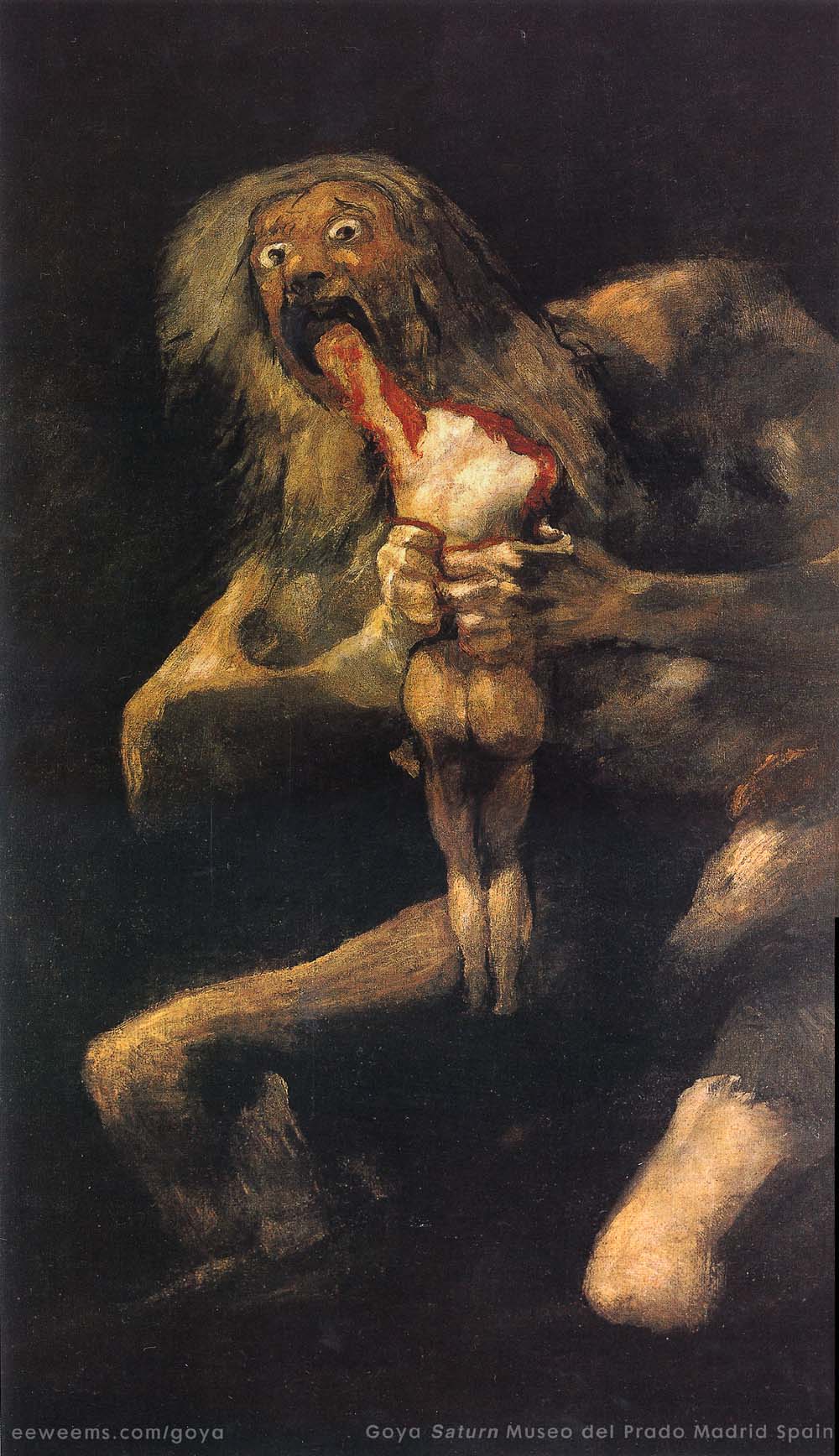
This begins what will hopefully become a regular series of posts on art criticism focused around those pieces with specific applications to our ongoing investigation of sleep-eating. Today’s selection, Saturn Devouring His Son, was only the most obvious and disturbing of a large collection we plan on glossing.

Francisco Goya’s overeager biographers are quick to point out that the artist’s diminishing eyesight and growing isolation at the end of his life contributed to the gloomy oeuvre of his later work. I am quick to point out that the dude was painting depressing shit his whole life, and that if anything changed when he went blind it was only a matter of degree.

Oh, cheer up, Mr. Sappy-pants!

Another frequently held opinion about the work is that it somehow represents blindness and insanity; the madness that a rapidly encroaching death confers on the elderly. Erik Weems writes, “[Goya] renders [him] blatantly insane, Saturn shown without any recognizable expression of premeditation.” This line of interpretation belongs in O magazine, just above the picture of Oprah on a bicycle. I would first like to know what an “expression of premeditation” is. Perhaps when a cannibalistic act is premeditated the cannibal in question achieves an inner peace as he consumes his/her victims. Apparently Erik Weems knows about these things. I must admit I do not.

Erik Weems can tell this was not planned.

What I do know about is the painting itself, and although it is impossible to determine premeditation from it, Goya does leave us with substantial clues as to its interpretation. The original myth has Saturn assured of his children's eventual usurpation of his role. Thus motivated, he eats them in order to prevent his eventual downfall. Samuel Beckett seems to substantiate Saturn’s concerns when he says, “there is no hope, for everyone is a parent.” And, yes, that is a pun: Beckett was fond of them.

In defense of Erik Weems’ position, there is something jarring in Saturn’s expression; namely, he does not look on his victim (his son) but gazes past him and out at the audience. The resulting experience (for the viewer) is the impression that Saturn is more interested in us than in the son he is devouring.

The act of cannibalism is often referred to as “primal,” or, alternately, “savage.” These are both words, coincidentally, that were used in a recent Cosmopolitan article that heralded fucking against a wall as the greatest sexual position. On the one hand is the unthinkable crime: the familial betrayal of protective father against dependent son--like Abraham raising the axe above Isaac’s head; yet made even worse through the act of feeding. On the other hand is the thrilling sexual act, in which you are encouraged to claw at one another and scream in order to heighten the “primal” and “savage” enjoyment.

The question should be, How WILL you sleep when he's not there?

The disturbing point is that in the Cosmo-approved fucking there is a piece of Saturn Devouring His Children. The desires are crisscrossed: the perversion of food-lust has the meat of the ram transubstantiated into the helpless Isaac; the wall-fucking transforms procreation into mock-violence. Notice also how in the media food is frequently sexualized and vice-versa—not just in women’s magazines, but even things as (seemingly) harmless as advertisements for frozen pizza.

Death Mask and I have provided plenty of evidence already describing how sleep-eating connects with a distant past in which desires existed at their “primal” geneses. That is not to say that this “time” ever existed, but that it exists qua universal point of intersection of all human desire. This point of universal desire, of the excess of all possible satisfaction, exists dependent on the fact that it is impossible i.e. that it can never be symbolized or dominated by interpretation. Because it resists our efforts to subjugate it we strive towards it with stupid and blind stabs in the dark; we fuck against a wall or eat an entire frozen pizza while sleeping or watch Spielberg movies about the Holocaust. These efforts, however pleasurable in the short term, continue to deny us access to that point of original (terrible) joy. Instead we get only glimpses, only tiny crumbs off the enormous Whole.

Here, in Goya’s painting, rests the impossible Whole. It stares us in the face because it already knows us—knows us like it knows its own children.

23.8.08

All Heaven in the Sphincter

Well now there IS a germ-free alternative to traditional necking.

There are two ways of looking at the natural opposition of yourself and everyone else. The first, mostly influenced by Kant, describes an impassible void that mediates any experience between the self and the Other. This void is both compelling and repulsive; it attracts and denies the advances of the individual towards those outside him/herself. It is described as the focal point of human relations.

I think this is horseshit, and so does Jean Genet. He holds the opposite opinion, essentially that there is no void--that the chasm between self and Other is perpetually recreated by the self in an interminable effort to preserve the self. The real horror is not the idea of an impossibly unfathomable line separating oneself from the rest of humanity, but instead the concept of no differentiation at all. In his essay titled, "What Remains of a Rembrandt Torn into Four Equal Pieces and Flushed Down the Toilet," Genet describes the experience of realizing that he is exactly the same as a man with a "disgusting moustache" on the Paris Metro. The experience, for him, is more jarring than any difference between the two of them could be. In fact, he longs for difference to provide a source of solace as his realization is broadened.

Portrait intended for Genet's unpublished work, "What Remains of a Giacometti Torn into Four Equal Pieces and Flushed Down the Toilet."

Sleep-eating is perceived initially as a phenomenon contained wholly by the self. This would seem self-evident*. But the number of cases of sleep-eating that involve onlookers and bystanders has begun to pique my interest. Besides, one never remembers nor ever wholly witnesses one's own sleep-eating act. While it is taken as a matter of cause that the sleep- and food-lust that intersect in the act are universal, to what degree does the mediation of the act provide its own cathartic release of these universal tensions?

This post serves as notice of the development of a new branch of parasomnial investigation: the realm of the self v. the universal within the tradition of sleep-eating.

*I apologize for the pun, but I really can't help my self.

20.8.08

Of the Filthy, Sturdy, Unkillable Infants of the Very Poor


"As Gregor Samsa awoke one morning from uneasy dreams he found himself transformed in his bed into a gigantic insect."

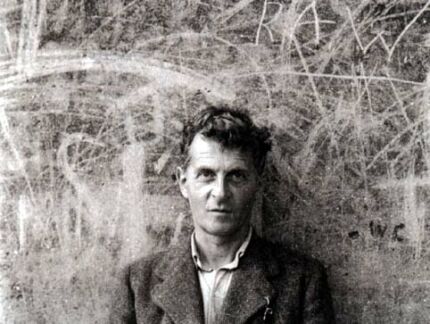
When talking about the supposed universality of Freud's theories on the repressed surfacing in sleep, Wittgenstein made reference to the inherent problem of semiology and dreams; whereas he agrees that dreams leave the unmistakable mark of decipherable signifiers in our consciousness, he disagrees that any "fluency" in this "language" is possible. His hypothetical example involves a man who claims fluency in French, but can only translate from French into English and lacks any and all ability to translate in the reverse direction. In other words, Freud fails (by his own standards of universality) at any claim to translate dreams.

Now, Wittgenstein is a crafty fellow, and many people are quick to point out his tendency towards ironic dialectic synthesis. He himself has said that the key to his Tractatus Logico Philosophicus is "what is not in it." The argument could be made that Wittgenstein only came up with a somewhat misleading hypothetical in order not to discredit Freud but instead to lend credence to his theories. Colleagues have claimed that Wittgenstein stated that he found the "Viennese fellow" compelling and "very interesting."


Did you realize this guy went to school with Hitler? No shit!

But what if we take the emphasis of Wittgenstein's hypothetical off of the relationship to psychoanalysis? What if we ask Wittgenstein a question (since Wittgenstein himself seems fond of asking Wittgenstein questions)? What if we say, but Herr Wittgenstein, isn't there someone who can translate truth into dreams?

Hegel says, "The soul is a bone." I say, "I am a private East Coast university." For years I defined myself against what I perceived as an imaginary line drawn between the elite world of academia and myself in the (pejoratively) public state university. Well, unfortunately for both my definition of myself as the stain on the otherwise rosy fall landscape on the metaphoric brochure photograph of academia and my bank account, I'm on the other side of the line. And what I've discovered about this line is that it does not belong to the realm of the imaginary. It is both of the Real and a prescient bit of reality. While the former may be a little more obvious, the latter was a shock to me. Every single building on campus is protected as though we are surrounded by flesh eating zombies. Lack of identification guarantees that you will not be allowed in anywhere, even to a classroom, without contacting the central identification office. The real benefit of crossing the line, I suppose, is that I am now of the "community" that can safely take a shit on a clean toilet. Before, I would have had to shit my pants on the subway like anyone else.


My own private hell/haven

Of course, my contempt for the world of private elitist universities was a rouse behind which I hid my true desire to be a part of that world. As always, my desire being realized is not a source of satisfaction, but instead a troubling sensation reminiscent of Freud's notion of the uncanny. Like in a nightmare, reality is changed only slightly--the result of which is more troubling than the complete suspension of recognizable reality. In this way, I feel that my original (waking) dream has been translated into reality, yet is intractably perceived as a dream, as something that demands interpretation. Only my familiarity with the illusion makes it seem any less uncomfortable and indecipherable than it is.

It's for this reason I stand by my question to Wittgenstein. True genius is not manifest in the discovery of truth, but in the domination of this truth qua transference to the realm of signification; in other words, into a dream.

30.7.08

Speaking of Asians (or Skipping the First Step and the Wonders of We Got Married)


The last month, month and a half, have seen a spike in my anxiety. I've been on the fringe of graduating, moving jobs, losing my two best friends to NYC (because of this YHTALMM is now a bi-coastal operation), inserting the Nuva Ring into my daily life, and moonlighting (because of this YHTALMM has a direct relationship with food service). My appetite has decreased twofold, and my nocturnal consumptions have barely stirred.

"Why serial killers?"

I get hungry much later in the day, and since I'm stuck behind a cash register when my appetite is aroused, I've been eating when I am not hungry at all in order to preempt late-afternoon hunger pangs. This is frustrating for me because eating is my primary drive for living. Life is merely a symptom of eating food. When one desire isn't being satisfied the psyche tends to shop for a substitute desire or pleasure as a coping mechanism. I've been filling my hunger-void with television. I watched the entire First Person series in two afternoons and have watched Gene Kelly's special appearance on The Muppet Show more times that I've watched Singin' In The Rain- which is a lot. My favorite show to surfeit on, the acme of my replacement enjoyment, is a Korean reality show called We Got Married. The only way I've been able to avoid binge watching TV shows, or Paul Newman interviews (I always end up with a face covered in tears), is by accident- when the food I ate as a plug is miraculously what I was truly hungry for. For instance, last week I stuffed a Kaiser roll into my bag then stole butter from my bookstore's adjoining coffee shop and stuffed it in my face before my next shift. I was accidentally satisfied. The Kaiser roll and butter were exactly what I needed, except I didn't recognize this until after they were consumed, which brings us back (thankfully), to We Got Married.

It's like my childhood made this for my adulthood!

My co-worker said it best, "You have to watch We Got Married with an open heart." That's the only advice you'll never need regarding the watchability of WGM. However, I do have a mouthful (pun intended) to comment on why I love this program as much as I do.

First a brief synopsis of WGM: South Korean celebrities are paired up in four sets and agree to live together in an assimilated marriage. The entertainment is not where you'd expect: in the States the show would be something of a parred down Surreal Life, where two marginally famous assholes are trapped in a house together and the camera would ensnare their senses of entitlement and overall dumbness. Don't get me wrong, I would watch the show I just described, but WGM operates above this. The celebrities chosen, although spoiled, are not rotting in the fame. They are all polite, thoughtful, and optimistic.

Andy Oppa made Solbi a princess bed.

What a show like this does to a Western audience is jarring. Reality shows are so boring, and the people who watch them are so bored, that the only residual enjoyment to be had in them is the factor of immediate kitch and intentional low-browing. WGM reinvests my interest in sincerity since I am watching it for its intended purpose. Though three of the paired couples are clearly going through the motions of the program, making the most of their uncomfortable situation with tepid chemistry, there is one pair (Andy and Solbi) whose faux marriage has struck a romantic chord in each of them. The function of the show, the nature of its setup, is what sparked an otherwise latent interest in a love affair. What WGM does, or did, to Andy and Solbi is swaddle them into a situation where each party is justifiably entitled to certain things (outing together, back rubs, home cooked meals, and comfort), whereas in Real romantic onsets both sides are often plagued by the discomfort of wanting to want something from the other party, and/or are confused by what they are to one another.

WGM
did all the work for Andy and Solbi. They are husband and wife, or at least have to preform as so, and are expected to familiarize each other with the quirks of their personalities for the camera. It's not, however, the quirks that have sparked the flame between the two, but the performance of them. Much akin to how Lacan points out the "performative" aspect of being a king in Hamlet (the king is charismatic and loved because he is treated as so, not the other way around), Andy and Solbi are drawn to each other by how they themselves are forced to treat the other person.

Not the first or the last time YHTALMM uses this image

They have skipped the most treacherous step of falling in love- the beginning. And are able to enjoy the joy of initiation (first kisses, etc) without the unbearable remainder of questioning reciprocity (after all they are married). Or fake-married, but to do a good job at their job (preforming in the television show) they must act in love. The situation is a win-win. Anxiety over behaving too enamored is wiped away, for the sake of the program, for the sake of the audience. Much like how I am only happy with what I eat if it's no longer premeditated, Andy and Solbi are in the midst of finding love because they were not seeking it. In fact both parties were probably questing for little more than money, or more notoriety, but what they've garnered in the end is much greater, and is also what the watching audience is hoping for.

9.7.08

An Eye Most Apt in Gelatines and Jupes


Everyone, in my experience, is aware of two ways to eat at a Chinese restaurant. The first involves every member of the dining party ordering a different dish from the menu. When the dishes arrive the entire party eats small helpings of every dish that has been ordered. If you happen to dislike something one of the dining party members ordered you deal with it privately; chances are someone resents you for your choice as well. This first method, I suppose, could be considered the “family style” method.

The second method is wrong.

For a long time this has been my de facto test of potential friends and sexual partners. If when the dishes arrive at the table the acquaintance pulls their ordered dish toward him/herself and removes the oversized serving spoon (an obvious sign of the superiority of the “family style”) I understand that the relationship will not advance from the table. From that point on I have the freedom to treat the meal like a farewell luncheon. I ask my failing acquaintance long-term questions about the direction s/he thinks his/her life might go. When we split the bill not into equal parts but instead pay individually for every dish ordered I am reminded of why I am letting this person disappear into the ether of my consciousness.


Fuck you, Time magazine

I do not read the introductions of books until I have finished the book that is being introduced. Generally this is so I can better ridicule the introducer. Usually the book will be introduced by a scholar with a chair in some prestigious east coast university. S/he will use his/her advanced biographical knowledge of the author s/he has attached him/herself to like a lamprey eel in order to illuminate the more obscure autobiographical notes of the text. Usually these observations can simply be summed up as “wrong,” or, as is often the case, “laughably wrong.” Occasionally a work of fiction will be introduced by a contemporary author judged to be similar to the master whose work demands introduction. Such is the case of the piece by John Updike which grows like a malignant tumor off the front end of the Complete Works of Franz Kafka. Updike has nothing to say about Kafka, and yet says it for nearly forty pages. If I were to sum up all the useful information a reader of Kafka could glean from reading Updike’s introduction, I would have to do it thusly:

“ .”


Conceal/Reveal

John V. Smyth, the author of The Habit of Lying, is fond of an example which in his estimation illustrates the extent to which deception naturally permeates and mediates human behavior. The example is clothing. It’s simple to understand, really: we choose our clothing as a means of disguising and defining ourselves. When the body is revealed as the clothing is removed, the viewer of the exposed body is treated (presumably) to the unveiling of a closely kept secret. Hence the historical ugliness associated with sharing your secret with too many people: once everyone knows about it it’s not much of a secret.

The problem with this example is that I’m convinced it’s completely ironic. Clothing is not the “natural” sign of man’s tendency towards deception—it’s the body itself. While the sloughing off of clothes is an easy way to illustrate the conceal/reveal move to power that dictates Foucault’s system of “confession,” it is an inherently false construction. Exposing your body only exposes the many different ways you are concealing anything and everything you do; it illustrates that human deception runs so deep it can only be sloughed off in the realm of the symbolic, dictated by the authority we all bow to when engaging in this erotic ritual. In this way, natural human deception is not mediated through dressing oneself, but by feeding oneself.


Deception mediates feline society as well.

I finished reading Enjoy Your Symptom! without reading the introduction (as usual). I was intrigued by any introduction to a Zizek work. Would Zizek allow a completely wrong introduction to preface his book? Or would he get one of the many brilliant people who are on a first-name basis with him (e.g. Judith Butler) to expose his many ironies? As I began reading it I was convinced of the former. The introduction writer begins by explaining how he hates the “family style” of eating Chinese food, “insist[ing on] finishing [his] plate alone.” Then he talks about the proposed psychoanalysis of this preference: a tablemate suggests that the introduction writer conceals his fear of sharing sexual partners with his “repulsion” towards sharing Chinese food dishes. The introduction writer then turns the haphazard psychoanalytical suggestion around by claiming that it would be more likely that one would insist on sharing sexual partners in order to disguise one’s hatred of sharing Chinese food. This kind of game is very cute and Zizekian but it ultimately left me wondering who this knob was that wrote the terrible introduction.

Of course it was Zizek.


The inherent question this all poses is, where is the act of concealing in sleep-eating? Is it the sleeping, or the eating? Furthermore, to what depths does the answer to the previous question suggest that human deception runs? How far do we go to deceive ourselves? And, lastly, is the sexual act always disguised by some other act (sharing Chinese food, etc.), or—as Nabokov once suggested—is it really always the other way around?