10.10.09

Never Neglect the Little Things of Life.


"What do you expect, you always wait till the last moment."

While we continue to anticipate the world-shattering piece my partner, Death Mask, will write on her worsening medical condition, I will post another gmail chat tibit to sate our appetites for all things YHTALMM. This conversation takes place between myself, HCE, and CLF, which stands for Cute Little Feet.

12:59 PM CLF: ...I don't know what goes on inside your head.
HCE: But you can imagine.
I think you should imagine the inside of my head as an interminable spy v. spy comic
1:00 PM That's pretty accurate

(9 minutes later)

1:09 PM HCE: Did you catch my spy v. spy comment?
I thought it was really good.
CLF: yes.
it was
are you filming me?

28.9.09

Fuck It


I was coerced. It's true. I was coerced into believing that Paul was the ethically superior Beatle. I don't want to go into the details of my coercion, I'd rather just skip to the moment of my enlightenment.


It's the song "Don't Let Me Down." John lays down the most ethical vision of idealistic love possible. It doubles as the message to the Beatles themselves. Don't let me down. Goddamn.

It's also the imperative of me to my partner, and, subsequently, her imperative to me.

Goddamn.

29.6.09

Where the Mountain Hare has Lain

My where has the time gone?

A simple question plagues me: how does one remember sleep eating?

The question persists in the field on account of the theoretical basis my partner and I have outlined. The basic premise has always been that there is an essential recapturing of a memory informed by the imaginary in the act of sleep eating. Evidence which can be gathered below, particularly in Death Mask’s fantastic bit on Freud and art ultimately predicting the sonambulent consumption of NutraGrain bars, as well as in my own serialized investigation of newspaper reports of Ambien side effects, points to the presence of a repressed spectral primitive past that surfaces in sleep in order to mandate the mass consumption of neophytic foodstuffs. If this is the case, what role can we ascribe to the way in which the sleep eating act is remembered, both by the participant and their helpless horrified teenage sons who look on in horror?

And flights of angels sing thee to thy rest

Heidegger’s project in Being and Time is often described as a rumination on the potential contexts of universality. If there is a “being” at all with which we can connect all human consciousness, surely all ideas of fundamentality must spring from this very location in time. Of course, when put in these terms the project looks hopelessly Cartesian, a hopelessness I wish to maintain throughout while simultaneously offering an apologia to those Heidegger fanatics who find the Descartes comparison unbearable.

The man depicted is not Martin Heidegger, ergo, the man depicted is not a Nazi sympathizer

The potential uses of Dasein have been explored in more depth than I care to give them in relation to the discussion of eating and sleeping, but the most important use—outside several references in Encore that Lacan makes to it, usually punny—is Derrida’s concept of the trace; a temporal shift that allows memory to act on signifiers and establish relations of competing subjectivities. 


The internet says Lacan really drew this

The importance of this critque, as it were, is that it locates comprehension outside the realm of absolute presence, a myth Derrida cheekily ascribes to Saussure’s original notions of linguistic signification. As shaky as his blame game can get, Derrida is right in noting the supplement embodied in memory—namely, the supplement that makes the whole system of Dasein work.


Quickly becoming my favorite collection of pictures in any YHTALMM post

But if any ontological view of the present needs a supplement, what is the present anyway?

What if instead of present and past in dialectical processes, subjectivity were really a dialectic of past and ur-past, or time and Autre-temps? What if the duality of time and memory, described by Samuel Beckett as “that double-headed monster of damnation and salvation,” were itself only a mote in a larger system of dualities?


Officially my favorite group of pictures for any YHTALMM post

Every memory of the sleep-eating act is therefore a play between the two times in which one can remember. The Ego, then, is only the memory, only the auditor of a speech that has already come before its time. The Id becomes the locus of mythic time, a time of cannibalism and castration that only redeems itself in the unbounded potential for enjoyment. The question of how one remembers sleep-eating may not be the question at all; instead let us ask when.


11.6.09

Life For Me Ain't Been No Crystal Stair


On account of the protracted lack of a response from my partner, Death Mask, in our series on the edible sexual, I publish this portion of a gmail chat recorded between the two of us on 4/8/9. The subject is, unconsciously, the incest prohibition. Enjoy.

DM: I want to make a game show in which you introduce your parents to your boyfriend by having him do a body shot off her
it's called Bodyshot Mom
3:16 PM HCE: Hmm.
Can we call it "Mommyshot"?
DM: MUCH BETTER!
thanks, I knew it needed somehting
HCE: It's what I'm here for.

4.2.09

Appealing Appetizing pt. 2


Dearest DM,

I understand your concern over the consumable sexual. The basic idea has always disturbed me as well: do we objectify all our desires in the same way? Can we never satiate the sexual urge because we lack the ability to absorb it into our own ego ideals? Is the song "Hungry Like the Wolf" smarter than I (or anyone else for that matter) give it credit for? This last possibility may be the most disturbing of all.

I have to draw attention to Freud here to remind you of the theory of infantile sexuality; in brief, that the baby begins sexual maturation by suckling on the mother's breast. The infant rationalizes the experience as an exchange as well: it consumes (subsumes) the mother's milk and delivers back to her the resulting faeces. The exchange further begins the development of desire in the oscillation of presence and absence. So much seems to rest on this experience; its subsequent evacuation into the imaginary (and the participle residue) no doubt provides the rational for the presence of lipstick-wearing candies in the symbolic order.

This is Real.

You and I both admire the genius of Charles Chaplin, director, when in The Gold Rush the tramp is transubstantiated into a bucking chicken. Here, the conventions of social interaction are overridden by the desire to consume—symbolic order, jouissance, etc. Likewise, the sexy green M&M is the sexual object distorted by the desire to taste. Does the same mechanism that allows lipstick and mascara to distort the social object into the sexual object then facilitate the move from chicken to chocolate? Can the primal hunger instinct be deformed the same way the survival instinct can?

Yes, This too, is Real

We are members of the collective that coined the phrases "hunger-memory" and "sleep-lust." We should be able to figure this shit out, right?

Your friend always and etc.,

HCE

p.s. Oh shit! What about that terrible song "Sex and Candy" that came out when we were in high school?

3.2.09

Appealing Appetizing pt. 1

Dear Good Friend,

I have long since ceased trying to understand the notion of "food fetishes"- saliva dissolving underwear, licking melted chocolate off a loved ones torso etc.- I dismiss the phenomenon as a happening that is just not meant for me.

What has come to irk me in recent weeks (I have waited to write you regarding this under the hope that the nagging will stop) is the appeal of personified products that (who?) take on the archetypes of the "sexy" one. I know there was a Squeeze-It Juice that (who?) fits into this category, also I'm almost sure there is a flavor of Runtz Candy of this variety as well. Look, I know this trend isn't new, I can trace it without much exertion back to the movie previews of the 1950's (I believe the Soda and/or Popcorn was "sexy"), but I cannot find a reason I can totally buy into for the purpose of these characterizations. I don't know where I'm going with this, but friend, I wanted to drop you a line so we can keep the lines of communication open in case you've lost sleep over this silly quandary as well.

As always, thank you,

Death Mask

1.2.09

Our Turn to Change


Dear YHTALMM enthusiasts,

As I'm sure you've heard, 2009 is a year of change--and our blog has no intention of being left in the era without change. We're changing too: in fact we've been in the midst of changing for the last few months. Months, that we're sure to you, seemed like months of silence. And in some ways this is true--my midrest stirrings have ceased and I no longer awaken to find food wrappers strewn in my sheets. While I'm grateful for said "clean" emergences into consciousness, I am not convinced that I have overcome the beast who demands to be fed while I rest. Instead, I believe I have catered (no pun intended) to the monster. Recently I have taken a job that sometimes keeps me up until five or so in the morning and my sleep-patterns have been disrupted entirely by the upheaval. The result, as far as I am can see, is that I now eat and eat consciously during the hours I would otherwise "sleep-eat".

What I am trying to confess is that I've given myself over to my illness and allow it to walk with me everywhere, anytime. What this means for the blog is the exact same thing. We no longer feel the need to transform our desires and remorse into a functioning Doctor Jekyll. In the coming days and weeks my colleague and I will resume You Have to Always Love Me More as a blog that now considers "sleep-eating" or what lays beneath "normal" desires as a Hyde who has triumphed.

25.8.08

Never to Leave that Valley his Fathers Called their Home.


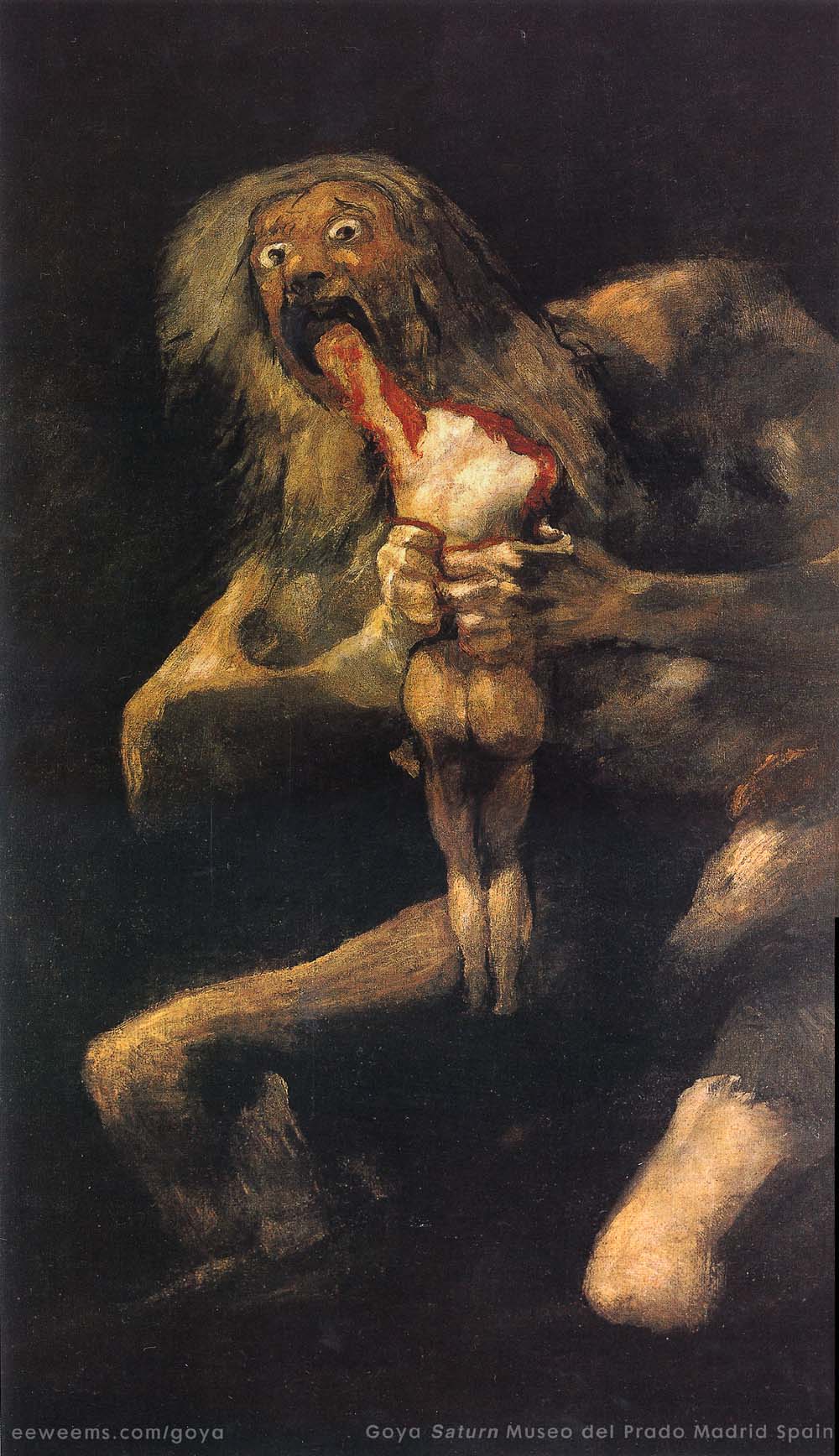
This begins what will hopefully become a regular series of posts on art criticism focused around those pieces with specific applications to our ongoing investigation of sleep-eating. Today’s selection, Saturn Devouring His Son, was only the most obvious and disturbing of a large collection we plan on glossing.

Francisco Goya’s overeager biographers are quick to point out that the artist’s diminishing eyesight and growing isolation at the end of his life contributed to the gloomy oeuvre of his later work. I am quick to point out that the dude was painting depressing shit his whole life, and that if anything changed when he went blind it was only a matter of degree.

Oh, cheer up, Mr. Sappy-pants!

Another frequently held opinion about the work is that it somehow represents blindness and insanity; the madness that a rapidly encroaching death confers on the elderly. Erik Weems writes, “[Goya] renders [him] blatantly insane, Saturn shown without any recognizable expression of premeditation.” This line of interpretation belongs in O magazine, just above the picture of Oprah on a bicycle. I would first like to know what an “expression of premeditation” is. Perhaps when a cannibalistic act is premeditated the cannibal in question achieves an inner peace as he consumes his/her victims. Apparently Erik Weems knows about these things. I must admit I do not.

Erik Weems can tell this was not planned.

What I do know about is the painting itself, and although it is impossible to determine premeditation from it, Goya does leave us with substantial clues as to its interpretation. The original myth has Saturn assured of his children's eventual usurpation of his role. Thus motivated, he eats them in order to prevent his eventual downfall. Samuel Beckett seems to substantiate Saturn’s concerns when he says, “there is no hope, for everyone is a parent.” And, yes, that is a pun: Beckett was fond of them.

In defense of Erik Weems’ position, there is something jarring in Saturn’s expression; namely, he does not look on his victim (his son) but gazes past him and out at the audience. The resulting experience (for the viewer) is the impression that Saturn is more interested in us than in the son he is devouring.

The act of cannibalism is often referred to as “primal,” or, alternately, “savage.” These are both words, coincidentally, that were used in a recent Cosmopolitan article that heralded fucking against a wall as the greatest sexual position. On the one hand is the unthinkable crime: the familial betrayal of protective father against dependent son--like Abraham raising the axe above Isaac’s head; yet made even worse through the act of feeding. On the other hand is the thrilling sexual act, in which you are encouraged to claw at one another and scream in order to heighten the “primal” and “savage” enjoyment.

The question should be, How WILL you sleep when he's not there?

The disturbing point is that in the Cosmo-approved fucking there is a piece of Saturn Devouring His Children. The desires are crisscrossed: the perversion of food-lust has the meat of the ram transubstantiated into the helpless Isaac; the wall-fucking transforms procreation into mock-violence. Notice also how in the media food is frequently sexualized and vice-versa—not just in women’s magazines, but even things as (seemingly) harmless as advertisements for frozen pizza.

Death Mask and I have provided plenty of evidence already describing how sleep-eating connects with a distant past in which desires existed at their “primal” geneses. That is not to say that this “time” ever existed, but that it exists qua universal point of intersection of all human desire. This point of universal desire, of the excess of all possible satisfaction, exists dependent on the fact that it is impossible i.e. that it can never be symbolized or dominated by interpretation. Because it resists our efforts to subjugate it we strive towards it with stupid and blind stabs in the dark; we fuck against a wall or eat an entire frozen pizza while sleeping or watch Spielberg movies about the Holocaust. These efforts, however pleasurable in the short term, continue to deny us access to that point of original (terrible) joy. Instead we get only glimpses, only tiny crumbs off the enormous Whole.

Here, in Goya’s painting, rests the impossible Whole. It stares us in the face because it already knows us—knows us like it knows its own children.

23.8.08

All Heaven in the Sphincter

Well now there IS a germ-free alternative to traditional necking.

There are two ways of looking at the natural opposition of yourself and everyone else. The first, mostly influenced by Kant, describes an impassible void that mediates any experience between the self and the Other. This void is both compelling and repulsive; it attracts and denies the advances of the individual towards those outside him/herself. It is described as the focal point of human relations.

I think this is horseshit, and so does Jean Genet. He holds the opposite opinion, essentially that there is no void--that the chasm between self and Other is perpetually recreated by the self in an interminable effort to preserve the self. The real horror is not the idea of an impossibly unfathomable line separating oneself from the rest of humanity, but instead the concept of no differentiation at all. In his essay titled, "What Remains of a Rembrandt Torn into Four Equal Pieces and Flushed Down the Toilet," Genet describes the experience of realizing that he is exactly the same as a man with a "disgusting moustache" on the Paris Metro. The experience, for him, is more jarring than any difference between the two of them could be. In fact, he longs for difference to provide a source of solace as his realization is broadened.

Portrait intended for Genet's unpublished work, "What Remains of a Giacometti Torn into Four Equal Pieces and Flushed Down the Toilet."

Sleep-eating is perceived initially as a phenomenon contained wholly by the self. This would seem self-evident*. But the number of cases of sleep-eating that involve onlookers and bystanders has begun to pique my interest. Besides, one never remembers nor ever wholly witnesses one's own sleep-eating act. While it is taken as a matter of cause that the sleep- and food-lust that intersect in the act are universal, to what degree does the mediation of the act provide its own cathartic release of these universal tensions?

This post serves as notice of the development of a new branch of parasomnial investigation: the realm of the self v. the universal within the tradition of sleep-eating.

*I apologize for the pun, but I really can't help my self.

20.8.08

Of the Filthy, Sturdy, Unkillable Infants of the Very Poor


"As Gregor Samsa awoke one morning from uneasy dreams he found himself transformed in his bed into a gigantic insect."

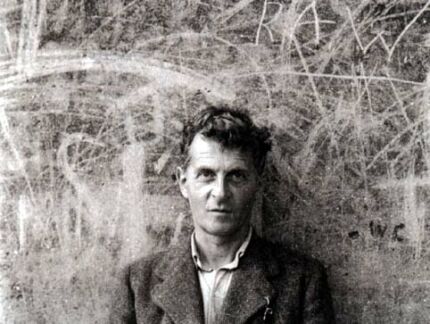
When talking about the supposed universality of Freud's theories on the repressed surfacing in sleep, Wittgenstein made reference to the inherent problem of semiology and dreams; whereas he agrees that dreams leave the unmistakable mark of decipherable signifiers in our consciousness, he disagrees that any "fluency" in this "language" is possible. His hypothetical example involves a man who claims fluency in French, but can only translate from French into English and lacks any and all ability to translate in the reverse direction. In other words, Freud fails (by his own standards of universality) at any claim to translate dreams.

Now, Wittgenstein is a crafty fellow, and many people are quick to point out his tendency towards ironic dialectic synthesis. He himself has said that the key to his Tractatus Logico Philosophicus is "what is not in it." The argument could be made that Wittgenstein only came up with a somewhat misleading hypothetical in order not to discredit Freud but instead to lend credence to his theories. Colleagues have claimed that Wittgenstein stated that he found the "Viennese fellow" compelling and "very interesting."


Did you realize this guy went to school with Hitler? No shit!

But what if we take the emphasis of Wittgenstein's hypothetical off of the relationship to psychoanalysis? What if we ask Wittgenstein a question (since Wittgenstein himself seems fond of asking Wittgenstein questions)? What if we say, but Herr Wittgenstein, isn't there someone who can translate truth into dreams?

Hegel says, "The soul is a bone." I say, "I am a private East Coast university." For years I defined myself against what I perceived as an imaginary line drawn between the elite world of academia and myself in the (pejoratively) public state university. Well, unfortunately for both my definition of myself as the stain on the otherwise rosy fall landscape on the metaphoric brochure photograph of academia and my bank account, I'm on the other side of the line. And what I've discovered about this line is that it does not belong to the realm of the imaginary. It is both of the Real and a prescient bit of reality. While the former may be a little more obvious, the latter was a shock to me. Every single building on campus is protected as though we are surrounded by flesh eating zombies. Lack of identification guarantees that you will not be allowed in anywhere, even to a classroom, without contacting the central identification office. The real benefit of crossing the line, I suppose, is that I am now of the "community" that can safely take a shit on a clean toilet. Before, I would have had to shit my pants on the subway like anyone else.


My own private hell/haven

Of course, my contempt for the world of private elitist universities was a rouse behind which I hid my true desire to be a part of that world. As always, my desire being realized is not a source of satisfaction, but instead a troubling sensation reminiscent of Freud's notion of the uncanny. Like in a nightmare, reality is changed only slightly--the result of which is more troubling than the complete suspension of recognizable reality. In this way, I feel that my original (waking) dream has been translated into reality, yet is intractably perceived as a dream, as something that demands interpretation. Only my familiarity with the illusion makes it seem any less uncomfortable and indecipherable than it is.

It's for this reason I stand by my question to Wittgenstein. True genius is not manifest in the discovery of truth, but in the domination of this truth qua transference to the realm of signification; in other words, into a dream.

30.7.08

Speaking of Asians (or Skipping the First Step and the Wonders of We Got Married)


The last month, month and a half, have seen a spike in my anxiety. I've been on the fringe of graduating, moving jobs, losing my two best friends to NYC (because of this YHTALMM is now a bi-coastal operation), inserting the Nuva Ring into my daily life, and moonlighting (because of this YHTALMM has a direct relationship with food service). My appetite has decreased twofold, and my nocturnal consumptions have barely stirred.

"Why serial killers?"

I get hungry much later in the day, and since I'm stuck behind a cash register when my appetite is aroused, I've been eating when I am not hungry at all in order to preempt late-afternoon hunger pangs. This is frustrating for me because eating is my primary drive for living. Life is merely a symptom of eating food. When one desire isn't being satisfied the psyche tends to shop for a substitute desire or pleasure as a coping mechanism. I've been filling my hunger-void with television. I watched the entire First Person series in two afternoons and have watched Gene Kelly's special appearance on The Muppet Show more times that I've watched Singin' In The Rain- which is a lot. My favorite show to surfeit on, the acme of my replacement enjoyment, is a Korean reality show called We Got Married. The only way I've been able to avoid binge watching TV shows, or Paul Newman interviews (I always end up with a face covered in tears), is by accident- when the food I ate as a plug is miraculously what I was truly hungry for. For instance, last week I stuffed a Kaiser roll into my bag then stole butter from my bookstore's adjoining coffee shop and stuffed it in my face before my next shift. I was accidentally satisfied. The Kaiser roll and butter were exactly what I needed, except I didn't recognize this until after they were consumed, which brings us back (thankfully), to We Got Married.

It's like my childhood made this for my adulthood!

My co-worker said it best, "You have to watch We Got Married with an open heart." That's the only advice you'll never need regarding the watchability of WGM. However, I do have a mouthful (pun intended) to comment on why I love this program as much as I do.

First a brief synopsis of WGM: South Korean celebrities are paired up in four sets and agree to live together in an assimilated marriage. The entertainment is not where you'd expect: in the States the show would be something of a parred down Surreal Life, where two marginally famous assholes are trapped in a house together and the camera would ensnare their senses of entitlement and overall dumbness. Don't get me wrong, I would watch the show I just described, but WGM operates above this. The celebrities chosen, although spoiled, are not rotting in the fame. They are all polite, thoughtful, and optimistic.

Andy Oppa made Solbi a princess bed.

What a show like this does to a Western audience is jarring. Reality shows are so boring, and the people who watch them are so bored, that the only residual enjoyment to be had in them is the factor of immediate kitch and intentional low-browing. WGM reinvests my interest in sincerity since I am watching it for its intended purpose. Though three of the paired couples are clearly going through the motions of the program, making the most of their uncomfortable situation with tepid chemistry, there is one pair (Andy and Solbi) whose faux marriage has struck a romantic chord in each of them. The function of the show, the nature of its setup, is what sparked an otherwise latent interest in a love affair. What WGM does, or did, to Andy and Solbi is swaddle them into a situation where each party is justifiably entitled to certain things (outing together, back rubs, home cooked meals, and comfort), whereas in Real romantic onsets both sides are often plagued by the discomfort of wanting to want something from the other party, and/or are confused by what they are to one another.

WGM
did all the work for Andy and Solbi. They are husband and wife, or at least have to preform as so, and are expected to familiarize each other with the quirks of their personalities for the camera. It's not, however, the quirks that have sparked the flame between the two, but the performance of them. Much akin to how Lacan points out the "performative" aspect of being a king in Hamlet (the king is charismatic and loved because he is treated as so, not the other way around), Andy and Solbi are drawn to each other by how they themselves are forced to treat the other person.

Not the first or the last time YHTALMM uses this image

They have skipped the most treacherous step of falling in love- the beginning. And are able to enjoy the joy of initiation (first kisses, etc) without the unbearable remainder of questioning reciprocity (after all they are married). Or fake-married, but to do a good job at their job (preforming in the television show) they must act in love. The situation is a win-win. Anxiety over behaving too enamored is wiped away, for the sake of the program, for the sake of the audience. Much like how I am only happy with what I eat if it's no longer premeditated, Andy and Solbi are in the midst of finding love because they were not seeking it. In fact both parties were probably questing for little more than money, or more notoriety, but what they've garnered in the end is much greater, and is also what the watching audience is hoping for.

9.7.08

An Eye Most Apt in Gelatines and Jupes


Everyone, in my experience, is aware of two ways to eat at a Chinese restaurant. The first involves every member of the dining party ordering a different dish from the menu. When the dishes arrive the entire party eats small helpings of every dish that has been ordered. If you happen to dislike something one of the dining party members ordered you deal with it privately; chances are someone resents you for your choice as well. This first method, I suppose, could be considered the “family style” method.

The second method is wrong.

For a long time this has been my de facto test of potential friends and sexual partners. If when the dishes arrive at the table the acquaintance pulls their ordered dish toward him/herself and removes the oversized serving spoon (an obvious sign of the superiority of the “family style”) I understand that the relationship will not advance from the table. From that point on I have the freedom to treat the meal like a farewell luncheon. I ask my failing acquaintance long-term questions about the direction s/he thinks his/her life might go. When we split the bill not into equal parts but instead pay individually for every dish ordered I am reminded of why I am letting this person disappear into the ether of my consciousness.


Fuck you, Time magazine

I do not read the introductions of books until I have finished the book that is being introduced. Generally this is so I can better ridicule the introducer. Usually the book will be introduced by a scholar with a chair in some prestigious east coast university. S/he will use his/her advanced biographical knowledge of the author s/he has attached him/herself to like a lamprey eel in order to illuminate the more obscure autobiographical notes of the text. Usually these observations can simply be summed up as “wrong,” or, as is often the case, “laughably wrong.” Occasionally a work of fiction will be introduced by a contemporary author judged to be similar to the master whose work demands introduction. Such is the case of the piece by John Updike which grows like a malignant tumor off the front end of the Complete Works of Franz Kafka. Updike has nothing to say about Kafka, and yet says it for nearly forty pages. If I were to sum up all the useful information a reader of Kafka could glean from reading Updike’s introduction, I would have to do it thusly:

“ .”


Conceal/Reveal

John V. Smyth, the author of The Habit of Lying, is fond of an example which in his estimation illustrates the extent to which deception naturally permeates and mediates human behavior. The example is clothing. It’s simple to understand, really: we choose our clothing as a means of disguising and defining ourselves. When the body is revealed as the clothing is removed, the viewer of the exposed body is treated (presumably) to the unveiling of a closely kept secret. Hence the historical ugliness associated with sharing your secret with too many people: once everyone knows about it it’s not much of a secret.

The problem with this example is that I’m convinced it’s completely ironic. Clothing is not the “natural” sign of man’s tendency towards deception—it’s the body itself. While the sloughing off of clothes is an easy way to illustrate the conceal/reveal move to power that dictates Foucault’s system of “confession,” it is an inherently false construction. Exposing your body only exposes the many different ways you are concealing anything and everything you do; it illustrates that human deception runs so deep it can only be sloughed off in the realm of the symbolic, dictated by the authority we all bow to when engaging in this erotic ritual. In this way, natural human deception is not mediated through dressing oneself, but by feeding oneself.


Deception mediates feline society as well.

I finished reading Enjoy Your Symptom! without reading the introduction (as usual). I was intrigued by any introduction to a Zizek work. Would Zizek allow a completely wrong introduction to preface his book? Or would he get one of the many brilliant people who are on a first-name basis with him (e.g. Judith Butler) to expose his many ironies? As I began reading it I was convinced of the former. The introduction writer begins by explaining how he hates the “family style” of eating Chinese food, “insist[ing on] finishing [his] plate alone.” Then he talks about the proposed psychoanalysis of this preference: a tablemate suggests that the introduction writer conceals his fear of sharing sexual partners with his “repulsion” towards sharing Chinese food dishes. The introduction writer then turns the haphazard psychoanalytical suggestion around by claiming that it would be more likely that one would insist on sharing sexual partners in order to disguise one’s hatred of sharing Chinese food. This kind of game is very cute and Zizekian but it ultimately left me wondering who this knob was that wrote the terrible introduction.

Of course it was Zizek.


The inherent question this all poses is, where is the act of concealing in sleep-eating? Is it the sleeping, or the eating? Furthermore, to what depths does the answer to the previous question suggest that human deception runs? How far do we go to deceive ourselves? And, lastly, is the sexual act always disguised by some other act (sharing Chinese food, etc.), or—as Nabokov once suggested—is it really always the other way around?

18.6.08

Behind the curtain

For the first time in a long time I re-watched Singin' in the Rain and realized a common theme behind it, and my sleep eating. Both portray a monster in front of the curtain. In Singin in the Rain it's Lina Lamont, silent film's biggest starlet who's facing an imminent wake up call- talking pictures are invading and Lamont's shrill Jersey accent negates her regal screen persona. As a temporary fix for Lamont's (most) repelling attribute the film studio hires Kathy Selden (Debbie Reynold's) to dub all of Lamont's audio work. In the film's finest scene Lamont lip synchs to a packed house as Selden sings the film's namesake, hiding behind the curtain Lena is in front of. The irony of course being that even though Lena is in plain view, the curtain serves to hide her more so than it does Kathy.

In Singin' in the Rain's scope, the curtain serves to hide a bitter truth or remedy to the false. But what's interesting is that the remedy is actually more appealing than what's presented in front of the curtain. (Is this why My Fair Lady sucks and why I've always assumed The Matrix sucks?) Most obviously, Debbie Reynolds' Kathy Selden (cute) is the vocal stand in for Jean Hagan's Lina Lamont (thick). But we also see this in the film's positive portrayal of talkies (to the extent of it's presentation being a hyper-talkie- a musical). And then there's the great, abandon sound stage scene in which Gene Kelly's activates every gimmick a sound stage has to offer (fog, mood lighting, backdrops), just to tell Kathy how much he likes her.

A classic line dissecting the appeal of Hollywood is how "the extraordinary impersonate the ordinary" but films like Singin' in the Rain throw that dichotomy for a loop by doubling it; and when the fog threatens to clear around the façade, it reveals an even more savory Real. Gene Kelly is extraordinary impersonating the extraordinary (Don Lockwood). Musicals work best under this kind of doubling because the act of singing and dancing relies on an extraordinary skill. Les Girls, a Cukor directed Gene Kelly movie, relies on the same strategy- a performer is simply performing.

How all of this correlates to sleep-eating, specifically my sleep eating, is simple. I hate the act of falling asleep and attempt to fend it off nightly. This is not to be me mistaken with insomnia; I've always been envious of those who suffer from insomnia. It's not that I can't sleep, it's that I don't want to.

Maybe I should have brought up earlier in this forum (YHTALMM) my fear of death and loathing of sleep. I try to stay awake as long as possible to maximize my living, or wake-time. I fall asleep with a light purposefully left on in the hopes I'll re-awake in the night and start to read or write. I've only succeeded a handful of times but I still believe in my method and and patiently awaiting the day I wake up and read Light in August or write the first draft to a screenplay. Two nights ago this backfired- I left the Cary Grant movie Only Angels Have Wings playing and woke up thinking "If Cary Grant's dead, I'm going to die too." Most nights, however, I just fall asleep peaceful and disgusted with myself.

We never cryogenically freeze anyone good!

More often than the intended purpose, the light left on stirs me (I'm guessing) with the urge to eat. Sleep-eating, however, has provided me with the one topic of prose and a keen conversation starter at my new job (blog about my new job is on its way). What's behind the curtain of my embarrassing habit of slumber- ACTIVITY! Beautiful.

In Zizek's Parallax View he discusses a similar inquiry. As an audience we can see Lina's audience's perception of her and Kathy's persevering sweetness and talent. Or, we can oscillate between the two women (or the one woman and the acknowledgment of the other woman's existence) because of quick-cuts showing us what's in front of and behind the literal curtain.

Ah! Something wild!

As a sidenote, I'm thinking of creating another blog page called "Gave Birth to Monsters" centered on really hot/cute celebrities whose offspring are repugnant beasts like Debbie Reynolds (Carrie Fisher), Janet Leigh (Jamie Leigh Curtis), Tippi Hendren (Melanie Griffith).


11.6.08

A Sudden Blow: The Great Wings Beating Still


We here at YHTALMM are very pleased to announce the publication of the first ever YHTALMM guest lecture. Today’s visiting professor is TP (which probably stands for Tom Patriot) who will address food and the fear of flight. Following the lecture YHTALMM founding members Death Mask (DM) and HC Earwicker (HCE) will provide the first of what could prove to be several interpretive discussions/debates over the content.

Without further introduction, I’ll pass the podium to TP.

I was recently on a plane that almost crashed. Well, there was a loud sound from the engine, followed by a shaking. Several women made a noise that was halfway between a scream and a constipated moan. My ears popped and we moved closer to the layer of clouds beneath us. The captain came on over the loud speaker and said, "We're having some engine...pause (1...2...3)...irregularities, and we'll be making a (1...2...3) landing in Oklahoma City. Our descent was quicker than usual, or it seemed like it anyway. Not just to me, but to the muttering people around me, and the white-knuckled man in the aisle seat of my row. Maybe we we're actually safe all along, but the point is that none of the passengers seemed to think so.

When we had touched down and taxied to the gate, the flight attendant explained that we would be waiting in the otherwise-closed terminal for another plane to come from Austin and a crew from Dallas. It seemed it would be awhile. She did, however, mention that there would be refreshments served.

Now, considering that we all had, collectively, at least a fleeting sensation of impending death, I would have expected that to be the consensus topic of conversation--the what-does-it-all-mean and before-my-eyes and kids-growing-up-without-a-whatever bullshit seemed inevitable. I was wrong.

Pretzels. Flight 916 was mostly concerned about pretzels. Every topic of conversation I overheard was about snacks. "So, I guess they'll be serving us snacks." "The lady said there would be snacks, or food, or something...I hope it's something good." "God, they almost killed us, the least they could do is hurry up with those snacks." NOTE: I don't completely disagree with the last sentiment.

When the snacks did come (little bags of pretzels along with the standard array of non-alcoholic beverages that can be found listed in the back of your in-flight magazine...they wouldn't even give us the fucking booze!), it was what I would have expected the crowd to look like as it rushed toward the emergency rows of a burning fuselage. In my experience, no one really likes those little pretzels (not to be confused with the big pretzels you can get with a variety of dipping sauces as free samples at the mall), but will certainly eat them if they are placed in front of you. They seem, to me, like a totally neutral object. Not something one would scorn, but certainly nothing you feel a strong sense of desire toward.

Maybe it is just another indicator that Americans are fat and stupid (many of these passengers, I should note, were eating shitty airport food while we waited in Dallas...they couldn't have been THAT hungry). But I wonder if it was something more.

I know that your blog deals specifically with sleep-eating (many of my fellow passengers were, of course, asleep in that dark cabin prior to the rude awakening), but I wonder if there is any correlation between this specific type of gluttony and a brush with that eternal, final sleep.


HCE: Do you want to start or should I start?

DM: I’ll start.

HCE: Okay. Good.

DM: To answer TP's closing question, yes, there is a correlation between the sudden desire to eat and your flight’s brush with disaster. For example, you only have to watch Anthony Bourdain’s “No Reservations” for about ten minutes before Anthony asks his ethnic tour guides what their final meal would be if given the chance to choose. After an abrupt brush with death your fellow passengers were made aware how close they all came to forgoing their last meal-wish and as an attempt to regain a harness on the longevity of their lives. The passengers on Flight 916 immediately desired a food-object which is barely enjoyable, and non-substantial as if to say “I’m alive and going to live on to eat many, many meals and therefore I’m going to eat shit right now.”

HCE: I find Anthony Bourdain abrasive. I feel like he’s purposefully confrontational with the other chefs, like he’s trying to start shit. Although he was purposefully reverential when he went to el bulli because he knew that dude would fuck him up (in a strict culinary sense) if he played him like that. I don’t know that the food was necessarily an expression of the “will-to-live” like you suggest. I think it was more of an “anything to get through” kind of deal. I think the whole brush-with-death-gives-you-a-sunny-look-on-life thing originates from Hannah and Her Sisters, and now people feel obligated to have it. When I fell off the bow of a deep sea fishing boat and was pulled out of the sea I was mostly embarrassed that I almost killed myself. I certainly didn’t write a bucket list or some shit like that. I’m going to lob you a softball and close by positing that rather than being the affirmation of life that you suggest the pretzels signify what Zizek refers to as the “nothing” that fills the void of modern existence. I’ll let you elaborate because I know that will make you happy.

DM: Anthony Bourdain looks a lot like Humphrey Bogart and works for the Travel Network now, not the Food Network. And I’m not saying that those on board of TP’s flight consciously were aware of their renewed zest for living- I’m more trying to express how immediately after a near-death experience, humans revert back into killing themselves slowly. On Zizek’s “nothing”, you’re right, I really like talking about this. In Welcome to the Desert of the Real, the documentary unfortunately titled, ZIZEK!, Slavoj talks about how modern products are sold without their malignant quality. Coke without sugar, decaffeinated coffee, cyber-sex, etc. Pretzels, in TP’s experience acts as Zizek’s “nothing”. If the flight offered “the big pretzels you can get with a variety of dipping sauces as free samples at the mall,” they would no longer place themselves as the “nothing”. The reason why these products are interesting to Zizek is because he feels the “nothing-ness” quality makes their consumers feel like they always desire them: since they consist of nothing one can never satisfy their hunger for them.


HCE: Right. Right on. The thing about it is, in The Fragile Absolute, Zizek talks about how the “nothing” of meaningless and substanceless food products fills the “void” created by how the horrible unavoidable shit of human existence is slowly encroaching on everyday life. This “void,” according to Zizek, used to be filled with holy objects; beautiful works of art in the renaissance were the response to the dead babies that clogged the renaissance’s aqueducts. Now, though, the “void” is filled with “nothing.” In this case, the “void” is created by the imminent reality of a hollow metal tube filled with ash-crusted corpses. The “nothing” that the passengers stuffed their craws with just happened to be the most meaningless (free) object. Pretzels.

This is exactly how I’ve been thinking about sleep-eating lately. Like the waking part of life creates the “void,” and like Freud said in The Interpretation of Dreams, at the fundamental level dreams are simply the fulfillment of deferred waking desires. Therefore, since now all of our “holy objects” are food, the void that needs to be filled in sleep because of the omnipresent horror of waking life must be filled with “empty” calories.

DM: Freud also believed that dreams are presented as they are (through symbols) because if we saw our actual desires face to face, it would be so upsetting we’d wake up. Like if I were married but wanted to sleep with my husband’s brother, I might have a dream where I sleep with someone with his name or job or another signifier of the brother. Like in Annie Hall when Annie dreams that she breaks Frank Sinatra’s glasses. The film interprets this as her want to break away from her controlling relationship with Alvy Singer. TP mentions how certain items on the flight menu were made unorderable or unavailable. By barring specified objects (actual meals and actual drinks) the passengers were spared a total awakening to the trauma that had just occurred. Much like how I sleep-eat foods I feel no hunger for or are only partial foods of an entire craving (breakfast bars).

HCE: But in a way I feel like even if the shitty drinks and expensive sandwiches were available to buy, the majority of the people on the plane would choose the free pretzels, because they are the most arbitrary and meaningless (as a means of avoiding any choice). So, in a way I agree with your assertion that the alcohol and grinders are closer to the horror of true desire.

Two Woody Allen references, two Freud references, two Zizek references, THREE Anthony Bourdain references. What does that say about us? Also, how do you think the Death Wish plays into TP’s submission. Oops, that’s three for Freud.


DM: Okay, I agree with your first statement but I think that the passengers are more satisfied with having something barred from them than they would be if the menu was entirely open. They like the idea of having something they only marginally desire forced on them. Upping the Zizek reference to FOUR, he claims that there are two schools of fathering. The first being the “tough”, “patriarchal” father is the kind of parent who will force their child to call their grandparents every weekend, because “they have to.” The second is the father who tells his child to call his grandparents only if they want to- but what this ultimately does is make the child feel like they have to want to call their grandparents. In the end, Zizek believes that the first version of the father is the preferable one because it is less manipulating. People dislike choices and therefore the passengers aboard TP’s flight were relieved not to make one.

As far as Freud’s death wish goes, I hit upon that above when I noticed how after a confrontation with death, the passengers chose to consume an object which their body reacts negatively towards.

HCE: Wow. Thanks for that Death Wish illumination. Seriously enlightening.

Okay, I’m done being a dick. But I do really like your Strict Dad/Lenient Dad comment. You’re right. The passengers were relieved that the “for sale” items on the menu were disallowed. It represented the authority that they sorely longed for when “The captain came on over the loud speaker and said, 'We're having some engine...pause (1...2...3)...irregularities.' Like, if the captain had just said “Sorry, we’re all going to die. No cell phone use” the passengers would have been relieved.

Alright. Final thoughts. On a scale from 1 to 10 how YHTALMM is this?

DM: I like the new forum. I think it’s about a 7.5, pictures considered. We should do this to a film sometime soon.

HCE: I’ll concur. You had the first word and I want you to have the last one. Quick! Name the film we’ll make:

DM: P.S. She Fell Over.

9.6.08

Among his Dogs and Playthings, Who is Stirred


A Performance of Titus Andronicus Staged by Your Genetic Material.

I had promised some thoughts on the transubstantiation qua interchangeability of inheritable qualities in a previous post. The thing about inheritance is in the physical tangible sense the conversation does not just hinge on the a priori but demonstrates on the most basic level how we understand all a priori debate. In the pejorative sense we instinctually recognize the details of deformation in the parent body manifest in the child; this recognition of the duplicated other is as fundamental as shrinking away from a punch. Whether or not the actual genetic trait is as obvious as a hunchback the introspective Quasimodo provides the perfect signifier for the collective understanding of these a priori shortcomings; i.e. the pockmarks on a mother’s face predict and explain the poor skin that isolates the daughter. As I previously mentioned, this basic recognition is the explanation for all knowledge of the preexisting. To borrow a phrase from Spinoza, we identify the chain of cause and effect that explains away the present dependent on our intrinsic physical understanding of how children look and develop into their parents.

Yet common knowledge still fails us in its inability to recognize the similarity between these (perceivably) inescapable physical traits and the (assumed) avoidable mental ones. The thought that the development of the personality is a posteriori of any genetic interference is pure ridiculousness. The development of the hunchback ego follows a surprisingly identical path to the one of the hunchback father. Outside the sheer improbability of a cultural shift in the perception of hunchbacks, the same could hold true for countless repeated generations. And, personally speaking, if the Disney film can’t make hunchbacks lovable I don’t know what could (other than key passages from Malone Dies and Finnegans Wake).


You could probably read every word of Finnegans Wake and not realize this is the protagonist.

Although I’ve gone a long way to get to a simple point, Death Mask is right when she suggests sleep-eating could be dependent on her mother, just not in the way she might have hoped. In a sense, her sleep-eating was preordained; it exists as an a priori trait similar in all aspects to her hair and eye color. And in case anyone misunderstands me as arguing for the viability of fate, I suggest you read this post again. Now, ask yourself, what is the difference between fate and inevitable universality? Anything?


Big things cracking at YHTALMM. Sometime this week we get our first guest lecture, followed by sleep-eating in classic movies (by Death Mask) and the dissembling aspect of the corporal body (By HC Earwicker).

22.5.08

When We Were Children, Staying at the Archduke's


These twins both independently thought of the same cheesecake at the same time.

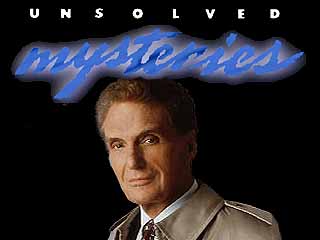
The actual ability of anyone to simultaneously come to the same conclusion as another without outside communication is commonly relegated to the realm of urban myth and Robert Stack’s steely narration of the episode of “Unsolved Mysteries” where those identical twins predict each other’s car wrecks. Or something like that. However, the phenomenon is considerably more normal and only goes to show that the reality of instructive structure and its limiting effects on the cultural boundaries of man’s natural inclinations make us much more alike than anyone would care to admit. Frequently the end result is the forced dissimulation of our congruence through the concussive interference of fists.


Fully two weeks of my childhood were spent solely in watching this program.

A historical example of this phenomenon (although it probably doesn’t even deserve that title) was frequently imparted to me by my favorite college professor; namely, the discovery of the calculus by Leibniz and Newton concordantly. If we can forgive the fact that it is supremely annoying when someone refers to it as “the Calculus” when “Calculus” would certainly suffice, we find evidence that shows (supposedly) that although the two were in frequent contact both Newton and Leibniz were so overwhelmed with paranoia that they refused to discuss with one another the enormous mathematical discovery they were both in the process of stumbling upon. When both published their findings within a year of one another their worst fears appeared to have been realized and they immediately hated each other with such a fervent ferocity it’s surprising Newton didn’t just stab Liebniz in the heart and throw him out a window. Although he may have, my historical knowledge is spotty.


Newton to Leibniz: Checkmate, bitch.

In any case, during my usual research on the continuing impotence with which modern medicine addresses sleep-eating (they call it “parasomnia” – HA!) I stumbled upon a passage that may encourage Death Mask to pursue a Newton v. Leibniz strategy with the author of Talkaboutsleep.com:

Sleep eating is more common in younger women. Symptoms typically begin in the late 20s. Episodes may reoccur, in combination with a stressful situation, or an episode may occur only once or twice. Additionally, many parasomnias seem to run in families, which may indicate that sleep eating is genetically linked. (From www.talkaboutsleep.com)

The interchangeable nature of genetic inheritance (i.e. a priori medicinal pseudo-physiological physical scientific anthrobiological deoxyribonucleic-acidic anatomical reproduction) and psychological inheritance (i.e. Freudian Elektral and Oedipal residual bricolage of inheritable and free-repeating trauma) will be further discussed at a later date. Succinct preview: contagion is ontologically and physically permeable.

21.5.08

Leftovers Pt. 2: Art = Nutrigrain


If there is a connection between butyric acid which stinks and the best perfumes, could we on that account put "the best perfume" in quotes? Could we therefore say: "the 'best' scent is really all sulphuric acid?"
- Wittgenstein